Structural Architecture · Scantlings & Metallurgy
Hulls: Strength Where Ice Meets Steel
When a vessel moves through ice-covered waters, the physics of hull loading shift from distributed hydrostatic pressure to intense, highly localized contact patches. A sheet of sea ice fails brightest in bending, not crushing. Therefore, an ice-capable hull must perform two tasks simultaneously: present an angled bow geometry that bends ice downward until it snaps in flexure, and possess sufficient shell plate thickness and internal framing stiffness to resist crushing loads before flexural break occurs.
Understanding what an ice-strengthened hull can safely endure requires separating Baltic first-year ice notations from Polar Class rules designed for multi-year ice inclusions.
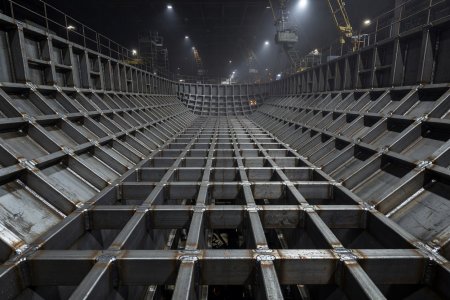
Fig 1.1 · Internal Ice Framing Grid
Intermediate frames placed at 350 mm intervals backed by deep load-carrying stringers prevent shell buckling between main web frames.
Classification Standards
Comparing IACS Polar Class and Finnish-Swedish Ice Classes
Historically, many expedition ships were built to the Finnish-Swedish Ice Class Rules (FSICR)—originally formulated by the Finnish Transport and Communications Agency (Traficom) and the Swedish Transport Agency for winter navigation in the northern Baltic Sea. Because Baltic ice is strictly seasonal (first-year) and brackish, the International Association of Classification Societies (IACS) introduced Unified Requirements URI (Polar Class PC1 to PC7) in 2007 to address high-latitude oceans where hard, desalinated multi-year ice and glacial fragments persist.
| Class Notation | Governing Standard | Nominal Ice Description (WMO Nomenclature) | Typical Vessel Application | Critical Operational Boundary |
|---|---|---|---|---|
| PC1 | IACS URI | Year-round operation in all Polar waters | Heavy government nuclear/diesel-electric polar icebreakers | Extreme fuel consumption and draft; still avoids large tabular icebergs |
| PC2 – PC3 | IACS URI | Year-round operation in moderate multi-year ice (PC2) or second-year ice with multi-year inclusions (PC3) | High-Arctic research icebreakers, dedicated icebreaking LNG/supply vessels | Speed must be throttled in heavy pressured ridges to avoid shaft overload |
| PC4 – PC5 | IACS URI | Year-round operation in thick (PC4: >1.2 m) or medium (PC5: 0.7–1.2 m) first-year ice with old ice inclusions | Long-range polar expedition ships and high-latitude scientific vessels | Not intended for continuous ramming of heavy multi-year polar pack |
| PC6 | IACS URI (approx. FSICR IA Super) | Summer/autumn operation in medium first-year ice (0.7–1.2 m) which may include old ice inclusions | Modern purpose-built polar expedition cruise and research vessels | Must route around heavy multi-year concentrations; vulnerable to high-speed growler strikes |
| PC7 | IACS URI (approx. FSICR IA) | Summer/autumn operation in thin first-year ice (0.3–0.7 m) which may include old ice inclusions | Seasonal Arctic/Antarctic coastal expedition vessels | Restricted to light pack and open brash channels during seasonal melt |
| FSICR IB / IC | Traficom / SMA | Light first-year brash ice (0.4–0.6 m), typically behind icebreaker escort | Sub-polar regional ferries, merchant cargo vessels, light explorer yachts | Zero structural margin for multi-year ice inclusions; requires escort in consolidated ice |
Sources: IACS Requirements Concerning Polar Class (URI1–URI3); Finnish-Swedish Ice Class Rules (Traficom / Swedish Transport Agency); IMO Polar Code (MSC.385(94) & MEPC.264(68)).
Metallurgy & Framing Mechanics
How Steel Chemistry and Frame Geometry Resist Crushing
Low-Temperature Fracture Toughness (Charpy V-Notch)
Ferritic carbon steel undergoes a ductile-to-brittle transition as ambient temperature drops. Below this transition temperature, a sharp impact from an ice floe can initiate a rapid cleavage crack rather than a benign local dent. IACS Polar Class rules classify hull structural regions into Material Classes (I through IV) and match them against the vessel's Polar Service Temperature (PST).
Where standard commercial ship hulls use Grade A mild steel tested at +20 °C, the ice belt of a PC5 or PC6 vessel utilizes fine-grain, normalized or thermo-mechanically controlled processed (TMCP) steels such as Grade D, Grade E, DH36, EH36, or FH36. Grade FH36 requires Charpy V-Notch impact energy verification at −60 °C, ensuring the hull plating yields plastically rather than shattering under subzero ice impact.
Transverse vs. Longitudinal Ice Framing
In open-ocean shipbuilding, longitudinal framing is favored in the midbody to resist global wave hogging and sagging. In the bow and ice belt of an ice-strengthened vessel, naval architects frequently employ transverse framing or closely spaced grillages. Whilemain frames may sit 800 mm apart, intermediate ice frames are inserted between them, cutting unsupported plate spans down to 300–400 mm.
These vertical ice frames are supported by horizontal load-carrying stringers and deep web frames. Additionally, the connection between the ice frame web and the shell plate must prevent "frame tripping" (lateral torsional buckling). Classification rules forbid unreinforced scallops or weld cut-outs in the high-shear zones of ice frames, requiring full collar plates and double-continuous fillet welds.
Rolled vs. Cast Steel Stem Posts
Function: The stem forms the leading edge of the bow where initial flexural ice breaking and ridge splitting occur.
Construction: Rather than thin welded plate stems, ice-class ships use solid cast steel or thick rolled bar stems backed by closely spaced breasthooks (horizontal triangular stiffener plates) every 400–600 mm vertically.
Forefoot Ice Knife: At the lower forefoot, a wedge-shaped skeg or ice knife deflects submerged ice blocks sideways so they travel clear of the bilge keels and propulsion intakes.
Low-Friction Ice Abrasion Coatings
Up to 60% of total hull resistance in broken ice comes from friction between snow-covered ice blocks and the hull skin. Ice-ready ships avoid soft self-polishing copper antifoulings in the ice belt; instead, they apply solvent-free, glass-flake reinforced epoxy (such as Marathon IQ or Inerta 160) heated during dual-component spraying to cure into a glass-hard, low-friction barrier.
Bow Hydrodynamics vs. Icebreaking Mechanics
The Compromise Between Open-Water Seakeeping and Ice Flexure
A dedicated polar icebreaker features a shallow stem angle (typically 18° to 24° to the horizontal) and flared buttock lines so the bow rides slightly onto the ice edge, using the ship's displacement weight to break the ice downward. However, when that same spoon-shaped icebreaker bow crosses choppy open water—such as the Drake Passage, Denmark Strait, or Barents Sea—it suffers severe bottom slamming, high added wave resistance, and uncomfortable pitching.
Expedition vessels that spend 70% of their voyage in open ocean and 30% in marginal ice zones must balance these competing physical demands:
- Hybrid Ice-Strengthened Bulbous Bows: Unlike fragile open-ocean bulbs that protrude forward of the stem and risk getting punctured or wedged under heavy ice floes, an ice-class bulbous bow is faired smoothly into a heavily reinforced stem contour, often acting as an underwater ice plow at ballast draft while reducing wave-making drag during ocean crossings.
- Inverted / Vertical Wave-Piercing Bows with IceWaterline Flare: Several modern PC6 expedition hulls pair an inverted upper bow profile (reducing wave slamming in head seas) with a sloped, heavily plated ice-breaking wedge positioned specifically across the design ice waterline.
- Hull Reamers and Midbody Flare: Because a vessel with a long parallel midbody can become pinched when lateral wind pressure closes an ice lead ("besetment"), some higher ice-class vessels incorporate widened bow shoulders ("reamers") that cut a channel slightly wider than the ship's stern beam, allowing easier turning inside pack ice.
Key Engineering Limitation: Regardless of bow profile, icestrengthening applies primarily to the designated ice belt, bow, and stern regions. If a ship rolls heavily in swell alongside hard ice cakes, or runs aground on an uncharted boulder moraine, the flat bottom plating below the lower ice belt experiences loads that can exceed even Polar Class design assumptions.