Auxiliary & Propulsion Engineering · Winterization
Equipment: Systems in Subzero Service
Even a heavily plated Polar Class hull can be immobilized within minutes if frazil ice blocks its main engine cooling water intake or if freezing sea spray locks its air intake louvers and deck cranes. Cold-weather marine engineering treats the ship as a thermal envelope where every fluid circuit, mechanical seal, and exposed actuator is matched to the vessel's Polar Service Temperature.
Below, we examine the three critical equipment groups that sustain operations in subzero conditions: seawater cooling architecture, ice-strengthened propulsion drivetrains, and topside deck winterization.
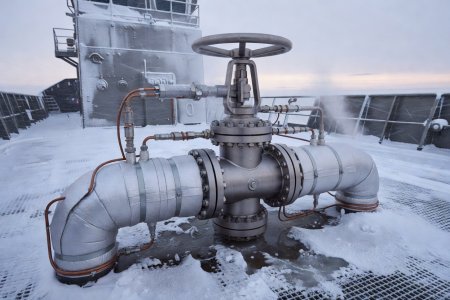
Fig 3.1 · Trace-Heated Deck Manifold
Self-regulating electric heat-trace cables and closed-cell insulation prevent valve stems from freezing solid during sea-spray events.
Subsystem 01 · Seawater Intakes & Cooling
Defeating Slush and Frazil Ice in Sea Chests
When a hull breaks through snow-covered ice or transits supercooled turbulent water, a thick slurry of small needle-like crystals (frazil ice) and crushed brash sweeps down the sides and bottom of the vessel. Standard side-mounted sea chests draw this slush directly into their strainer baskets, starving diesel generators and propulsion heat exchangers of cooling water and triggering immediate high-temperature engine shutdowns.
Ice-class ships defeat intake blockage through three layered engineering strategies:
- Deep Ice Sea Chests with Baffle Strainers: Placed as low as possible near the centerline keel, the ice sea chest has an enlarged internal volume so intake water velocity stays below 0.3–0.5 m/s, allowing buoyant ice crystals to float to the top of the chest rather than getting sucked into pump suctions.
- Warm Cooling Water Recirculation: Instead of discharging all heated seawater overboard after it passes through the engine room heat exchangers, a thermostatically controlled recirculation line routes up to 70% of the warm discharge water directly back into the sea chest bay, melting ingested slush before it reaches the strainer plates.
- Closed-Loop Hull Skin Tanks & Box Coolers: For emergency generators and auxiliary circuits, vessels use double-bottom ballast water as a closed heat-sink tank or deploy U-tube box coolers cooled by natural convection without pumping raw slush into narrow pipes.
Subsystem 02 · Drivetrains & Steering
Propellers, Podded Drives, and Rudder Ice Knives
Unlike open-water propellers optimized solely for hydrodynamic efficiency and low cavitation, an ice-class propulsion unit functions intermittently as an ice-milling machine. When the ship moves ahead—or backs down during a star turn in heavy pack—submerged ice blocks strike the rotating blades, generating bending moments and torsional shock loads several times higher than normal full-power hydrodynamic torque.
Controllable Pitch vs. Fixed Pitch
CPP Hubs & Blade Metallurgy
Controllable Pitch Propellers (CPP) allow bridge officers to reverse thrust rapidly without stopping and restarting a direct-coupled diesel engine—keeping water washing continuously across the rudder and hull. Ice-class CPP hubs use enlarged servo pistons and thick-root blades cast from high-strength Nickel-Aluminum-Bronze (Cu3/Cu4) or martensitic/austenitic stainless steel so that if an extreme overload occurs, a blade tip bends rather than shearing the internal hub mechanism or tailshaft.
Diesel-Electric & Azimuthing Pods
Podded Propulsors (Azipods)
Electric propulsion motors mounted inside 360-degree steerable pods deliver high starting torque at zero RPM and eliminate exposed rudders. On ice-class expedition ships, pods are reinforced with thickened strut castings, ice-deflecting fins, and triple-lip biodegradable shaft seals. By rotating thrust vectors side-to-side ("washing"), podded vessels can lubricate their own hull sides with propeller wash to break free when beset in pressured ice.
Steering Gear Protection
Rudder Ice Knives & Stops
On twin- or single-screw vessels with conventional rudders, backing into ice pushes floes directly against the trailing edge of the rudder blade, threatening to twist the rudder stock or burst steering gear hydraulic cylinders. A structural steel projection welded to the stern frame just aft of the rudder top—the rudder ice knife—slices or deflects ice blocks when the rudder is centered, while mechanical rudder stops and relief valves absorb lateral impacts.
Subsystem 03 · Topside Winterization & Anti-Icing
Combating Atmospheric and Sea-Spray Ice Accretion
The most acute threat to topside stability and equipment readiness is sea-spray icing. When wind speeds exceed 18–20 knots, air temperatures sit below −2.2 °C (the freezing point of typical ocean salinity), and sea surface temperatures are below +5 °C, wind-whipped wave spray freezes rapidly onto cold superstructures, railings, cranes, and lifeboat davits.
Unchecked ice accretion adds tens or hundreds of tonnes of high-center-of-gravity weight, degrades metacentric height ($GM$), and seals doors and tank vents shut. Classification societies offer dedicated winterization notations—such as DNV Winterized (Basic / Cold / Polar) or Lloyd's Register Winterisation—which govern anti-icing and de-icing design:
- Heated Tank Vents & Air Intakes: If ballast or fuel tank gooseneck vents freeze shut with rime ice, pumping out a tank creates an internal vacuum that can implode structural bulkheads. Polar vessels route tank vents inside heated deck trunks or fit steam-heated vent heads, and equip engine room combustion air intakes with heated droplet-separator louvers.
- Enclosed Foredecks & Whalebacks: Anchors, windlasses, and forward mooring winches are housed inside enclosed forecastle spaces (whalebacks) behind hydraulic shell doors, keeping chains and brake bands out of freezing spray while housing anchor hawsepipe steam-washing nozzles.
- Heated Walkways, Handrails & Scuppers: Escape corridors, muster stations, and gangways integrate hydronic glycol heating coils or electric heating mats beneath non-slip steel deck plates, paired with oversized, straight-drop heated scuppers so melted ice drains overboard rather than refreezing into sheet ice on deck.
Zodiac / Tender Launching Systems
Function: Enables rapid disembarkation of expedition teams and scientists in remote anchorages lacking piers.
Cold-Weather Features: Hydraulic shell doors open into an enclosed, heated sea-level marina or side platform protected from wind chill; cranes utilize low-temperature synthetic hydraulic oil (pour point below −54 °C) with sump heaters and ice-resistant wire sheaves.
Operational Limit: Swell height, katabatic wind gusts, and drifting brash ice at the side shell door govern launch safety regardless of crane heating capacity.